From Hallucination to Trust: How to Guardrail Enterprise Financial AI Before It Hits Investor Desks
By SolutionJet Architecture Team
The problem: small miscalculations, big consequences
An enterprise finance platform uses large language models to summarize quarterly earnings reports for analysts. The summaries read well, which is exactly the danger. A growth rate computed from the wrong base, a figure pulled from the prior-year column, or a percentage the model simply made up looks just as confident as a correct one. In financial reporting, one such error damages investor trust and can create regulatory exposure.
Better prompts reduce errors but never eliminate them. What's needed is a gate: no summary reaches an analyst until it has been scored against its sources.
The solution: online and offline evaluation
We use the Azure AI Evaluation SDK in two places:
- Online, on every summary: before a draft is shown, it's scored for groundedness (is every claim supported by the retrieved filings?) and similarity (is it close to an analyst-approved reference?), and every number is re-matched against the ledger in plain code.
- Offline, on every change: a golden dataset of past quarters runs through the same evaluators in CI. A new prompt or model version ships only if the scores hold.
Solution architecture and data flow
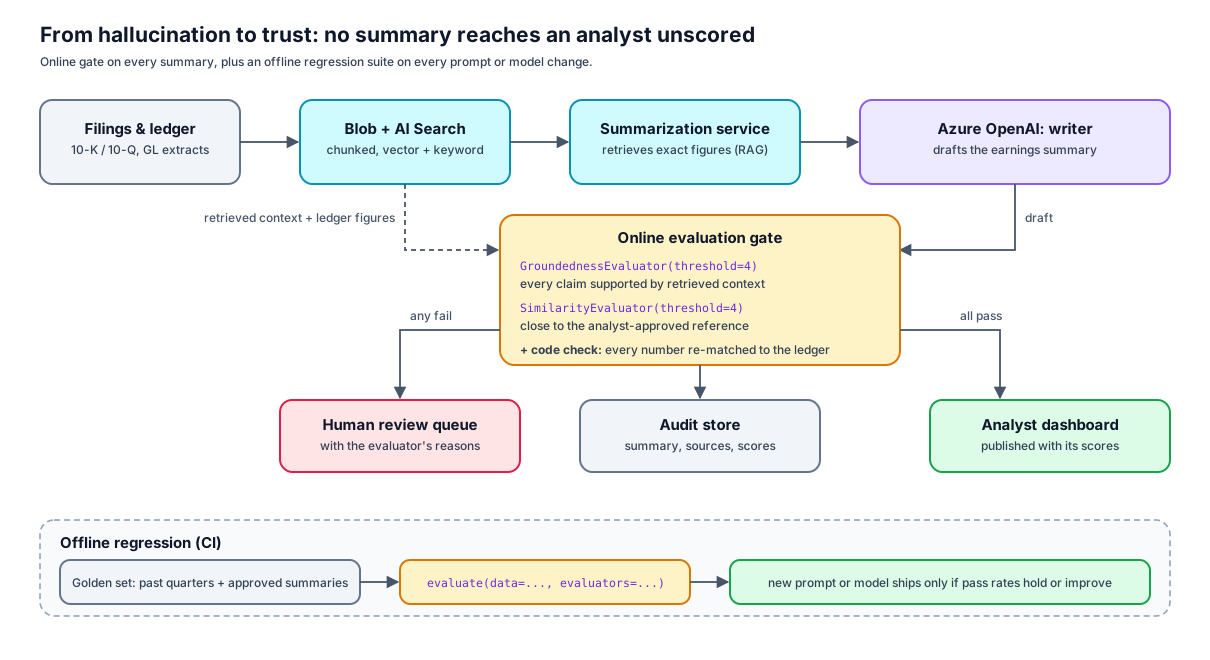
- Ingestion: 10-K/10-Q filings and general-ledger extracts land in Azure Blob Storage and are indexed in Azure AI Search (vector plus keyword).
- Grounded retrieval: the summarization service retrieves the exact passages and figures for the quarter (RAG).
- Generation: Azure OpenAI drafts the earnings summary from that context only.
- Evaluation gate: the draft, the retrieved context and the reference are scored:
- Groundedness: every statement must be supported by the source text.
- Similarity: the summary must stay close to the analyst-approved reference.
- Numeric check (code): every figure in the summary must appear in the ledger. LLM judges are good at meaning and weak at arithmetic, so numbers get a deterministic check.
- Release or review: summaries that pass go to the analyst dashboard with their scores attached; anything that fails goes to a human review queue with the evaluator's reasons. Both are written to an audit store.
The online gate
Each evaluator returns a 1–5 score, a reason, and a pass/fail result against the threshold you set. The gate reads the pass/fail results rather than hard-coding score comparisons:
import os
from azure.ai.evaluation import AzureOpenAIModelConfiguration, GroundednessEvaluator, SimilarityEvaluator

# The judge model. Use a different deployment than the one that wrote the summary.
judge = AzureOpenAIModelConfiguration(
    azure_endpoint=os.environ["AZURE_OPENAI_ENDPOINT"],
    azure_deployment="gpt-4o-judge",
    api_version="2024-10-21",
)

# Scores are 1-5; threshold sets the pass/fail cut for *_result.
groundedness = GroundednessEvaluator(judge, threshold=4)
similarity = SimilarityEvaluator(judge, threshold=4)


def gate(query: str, context: str, summary: str, analyst_reference: str) -> dict:
    """Score a generated earnings summary and decide whether it ships."""
    g = groundedness(query=query, context=context, response=summary)
    s = similarity(query=query, response=summary, ground_truth=analyst_reference)
    approved = g["groundedness_result"] == "pass" and s["similarity_result"] == "pass"
    return {
        "decision": "APPROVED" if approved else "HUMAN_REVIEW",
        "groundedness": g["groundedness"],
        "groundedness_reason": g["groundedness_reason"],
        "similarity": s["similarity"],
    }
Use a separate deployment as the judge, not the one that wrote the summary, so the model isn't grading its own work. Store the scores and reasons with every published summary: that becomes your audit trail.
The offline regression suite
Prompt tweaks and model upgrades are the most common source of silent regressions. Run the same evaluators over a golden dataset in CI and fail the build if quality drops:
from azure.ai.evaluation import evaluate
from gate import groundedness, similarity

results = evaluate(
    data="golden_set.jsonl",            # one row per past quarter: query, context, summary, reference
    evaluators={"groundedness": groundedness, "similarity": similarity},
    evaluator_config={
        "groundedness": {"column_mapping": {
            "query": "${data.query}", "context": "${data.context}", "response": "${data.summary}"}},
        "similarity": {"column_mapping": {
            "query": "${data.query}", "response": "${data.summary}", "ground_truth": "${data.reference}"}},
    },
    output_path="eval_results.json",
)

m = results["metrics"]                    # e.g. {"groundedness.groundedness": 4.6, ...}
assert m["groundedness.groundedness"] >= 4.5, m   # fail the pipeline: don't ship this prompt/model
assert m["similarity.similarity"] >= 4.0, m
Start the golden set with a handful of past quarters and their approved summaries, and add every summary a reviewer corrects. It grows into your best defence against regressions.
Key benefits
- Hallucinated figures are caught before release. A summary that isn't grounded, or whose numbers don't match the ledger, never reaches an analyst unreviewed.
- A continuous audit trail. Every published summary carries its sources, scores and reasons, which is what regulators and auditors ask for.
- Safe model upgrades. New models and prompts are judged on your own data before they ship, not after.
Takeaways
- Treat LLM output in regulated workflows as untrusted until scored.
- Combine LLM-judged metrics (groundedness, similarity) with deterministic checks for numbers.
- Use a different model deployment as the judge.
- Gate every prompt and model change on a golden dataset in CI.
References & further reading
- Microsoft Learn: Evaluate generative AI apps with the Azure AI Evaluation SDK
- Microsoft Learn: RAG evaluators (groundedness, relevance and more)
- Microsoft Learn: Observability in generative AI
- PyPI: azure-ai-evaluation
- Azure Architecture Center: Design and evaluate RAG solutions
- SolutionJet: RAG architecture for secure business apps on Azure
- SolutionJet: Orchestrating multi-step reasoning agents