
Architecting Resilient LLMOps: Real-Time Guardrails for Enterprise Decision Pipelines
By SolutionJet Architecture Team
Architecting Resilient LLMOps: Real-Time Guardrails for Enterprise Decision Pipelines
Generative AI in the enterprise has moved past the honeymoon phase of simple chatbots. When deploying non-deterministic systems for mission-critical workflows—like determining if a utility customer qualifies for a winter storm payment extension—statistical accuracy isn't enough. You need absolute control over runtime hallucinations, API latency, and operational budgets.
A complete LLMOps framework treats AI like reliable, production-ready software. It is not just about prompt engineering; it requires strict, end-to-end control across Prompt Management, Context Orchestration, Automated Evaluation, Tool Execution, Fine-Tuning, and Incident Response.
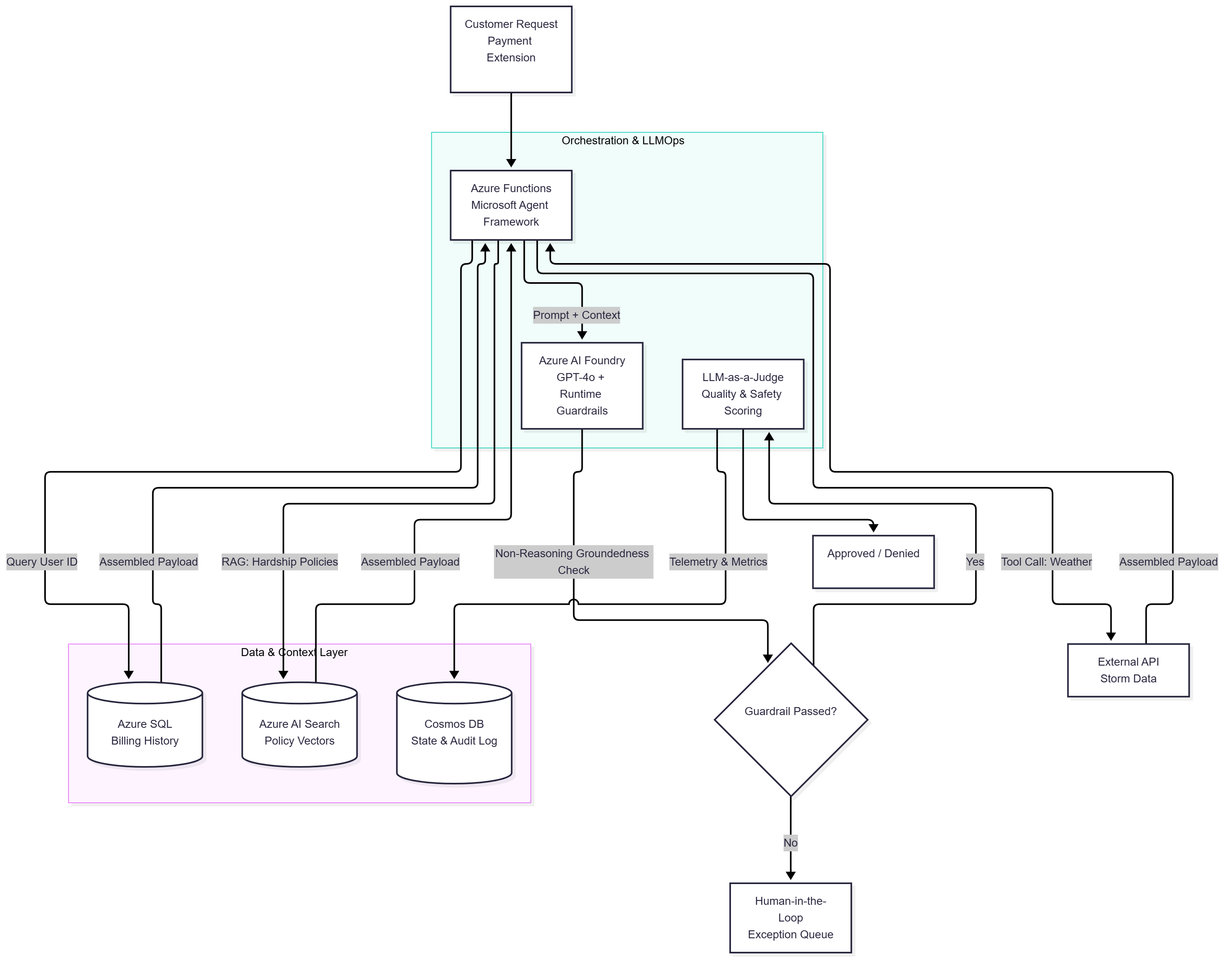
Below is a reference architecture and case study on how to build a robust, agentic decision pipeline on Azure, drawing from enterprise deployment patterns at utilities like Con Edison.
Deployed Architecture on Azure
The Problem
When a customer requests a payment extension due to a recent billing hike and a regional winter storm, the system must evaluate their billing history, unstructured corporate hardship policies, and external weather data. If the LLM hallucinates a policy clause or misinterprets a billing threshold, the company faces financial risk and compliance violations. Furthermore, running multi-step reasoning models (like GPT-4) on every request introduces unacceptable latency and budget bloat.
The Solution: Runtime Guardrails & LLMOps Pillars
To achieve this safely, we leverage a tightly coupled stack of Microsoft Agent Framework (MAF) on Azure Functions, backed by Azure AI Foundry for model execution and safety.
1. Context & Retrieval (RAG) Orchestration Instead of sending raw user prompts to the LLM, the MAF orchestrator intercepts the request and executes parallel tool calls. It queries Azure SQL for the customer's billing history, pulls localized weather data via external APIs, and performs a vector search against Azure AI Search for applicable payment relief policies. This strict data pipeline feeds only hard facts to the LLM, drastically reducing the surface area for hallucination.
2. Tool & Agent Execution (MAF on Azure Functions) We run the Microsoft Agent Framework natively on Azure Functions. MAF provides the robust graph-based orchestration needed for multi-step reasoning, while Azure Functions provides event-driven, serverless compute. This eliminates the idle costs associated with heavy Kubernetes clusters while dynamically scaling during localized events (like a sudden winter storm causing a spike in extension requests).
3. Runtime Hallucination Guardrails (Azure AI Content Safety) To tackle hallucinations on running code, we implement Azure AI Foundry's Groundedness Detection as a strict runtime guardrail.
- Latency Optimization: We configure the Groundedness filter to run in Non-Reasoning mode. This provides a fast, binary (true/false) check to ensure the LLM's decision is strictly anchored to the provided SQL data and Azure AI Search policy documents. It prevents the latency overhead of generating detailed explanations in production, keeping response times under 2 seconds.
- Budget Control: By catching ungrounded responses at the API boundary, we prevent flawed outputs from triggering further downstream processing or expensive rework.
4. Automated Evaluation (LLM-as-a-Judge) If the response passes the groundedness guardrail, it moves to an asynchronous LLM-as-a-Judge evaluation tier. Using a smaller, fine-tuned model (like GPT-4o-mini), we systematically score the output for tone, policy adherence, and safety. This acts as our telemetry. Instead of just measuring statistical accuracy, this scores the quality and relevance of the decision. The scores, along with the memory state, are logged to Cosmos DB.
5. Incident Response & CI/CD By treating prompts like source code and utilizing GitHub Agentic DevOps, we can version-control the prompt templates and A/B test them. If the LLM-as-a-Judge detects "drift" or a degradation in approval accuracy, our runbooks automatically reroute traffic to a previous prompt version or escalate edge cases to a human-in-the-loop queue.
Why This Approach?
Compared to a traditional monolithic application or a standard LangChain script running in a container, this architecture separates the orchestration (MAF/Azure Functions) from the cognitive engine (Azure AI Foundry).
- Cost vs. Accuracy: Using MAF allows us to route simple RAG queries to cheaper models, reserving heavy reasoning models only for edge-case evaluations.
- Built-in Safety: Relying on Foundry's native Groundedness guardrails is significantly faster and more reliable than trying to build custom prompt-based hallucination checks, which are easily bypassed.
- State Management: Leveraging Cosmos DB ensures we maintain isolated, batch-scoped worker memory, preventing context leakage between different customers' financial data.
References & further reading
More in this series
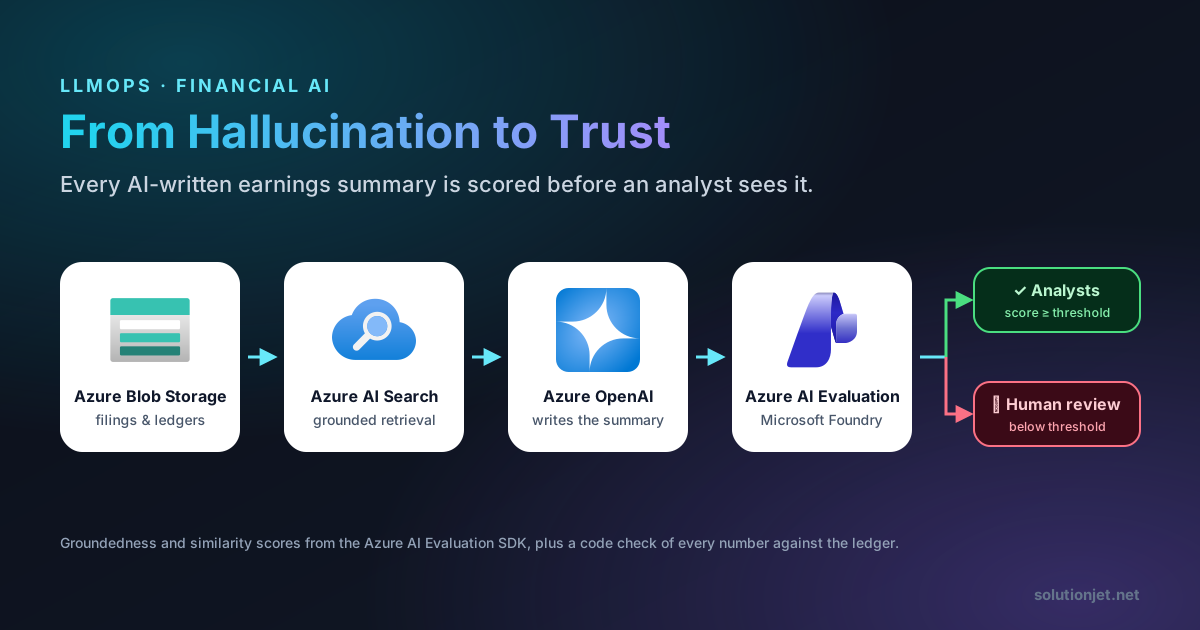
From Hallucination to Trust: How to Guardrail Enterprise Financial AI Before It Hits Investor Desks
Stop hallucinated figures before they reach investors: score every LLM-generated earnings summary for groundedness and similarity with the Azure AI Evaluation SDK, re-check the numbers in code, and gate model changes in CI.
Read Full Article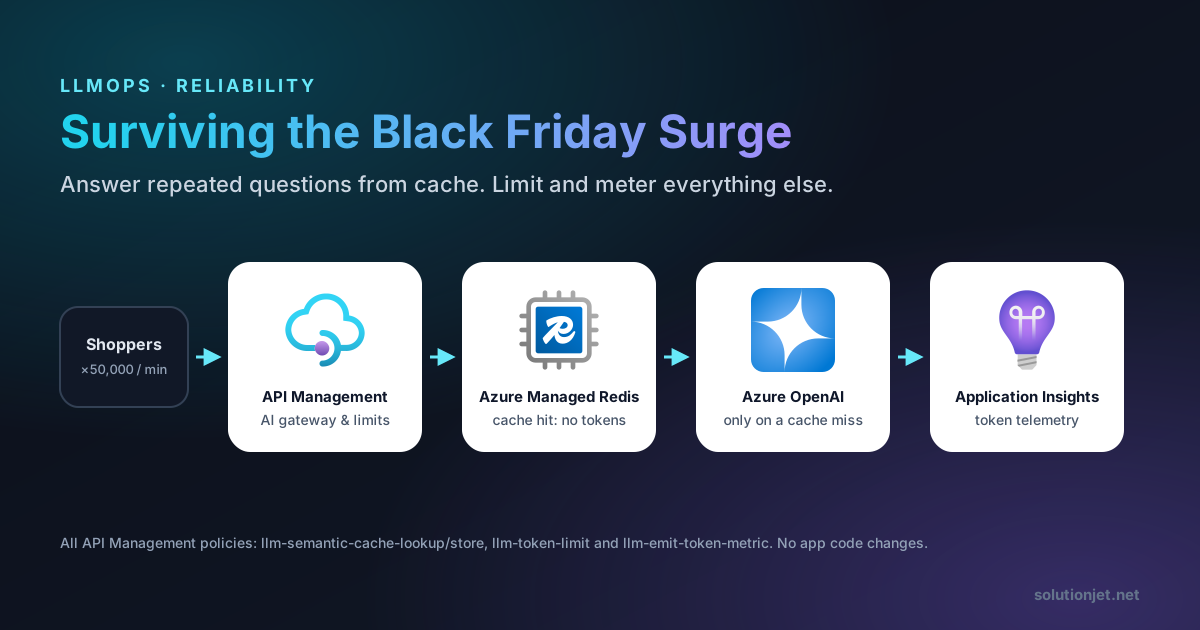
Surviving the Black Friday Surge: How Semantic Caching Saves Your LLM Budget
Keep an LLM-powered storefront fast and affordable during Black Friday spikes with API Management semantic caching on Azure Managed Redis, token limits, and token telemetry in Application Insights.
Read Full Article