
Beyond Brittle Wrappers: An Enterprise Agentic AI Architecture Blueprint for Ascensus
By SolutionJet Architecture Team
Target Audience: Enterprise Architects, Lead Systems Engineers, and AI Transformation Leaders
Disclaimer & Context Note
This system blueprint is an unsolicited reference architecture developed independently by SolutionJet. Ascensus is not a SolutionJet client, and this document does not describe work performed for Ascensus. It is grounded strictly in publicly available domain information regarding Ascensus’s retirement plan line of business, published platform features (including the Aimee virtual financial coach and My Forecast tools), and technical transformation mandate requirements. It is designed to illustrate how modern, enterprise-grade Agentic AI patterns can replace legacy tool wrappers and accelerate core business modernization.
Executive Summary: The Modernization Dilemma in Financial Services
Ascensus powers savings and retirement solutions for over 16 million savers across 401(k), SEP/SIMPLE IRAs, 529 Education Savings, and ABLE plans. Operating at this scale across brands like Newport, FuturePlan, and Provident Trust Group requires maintaining complex, multi-decade recordkeeping infrastructure while simultaneously delivering modern, AI-fueled digital experiences.
Ascensus has already established digital leadership with tools like My Forecast and Aimee, an AI-powered virtual financial coach backed by human planners. However, as enterprise financial services transition from static conversational assistants to autonomous, multi-step agentic workflows—such as automated participant distribution processing, loan payoff calculations, and SECURE 2.0 compliance testing—traditional software integration patterns hit a severe bottleneck.
Many engineering teams default to building custom API wrappers around each legacy endpoint for their Large Language Models (LLMs). While this works for simple pilots, in a multi-tenant financial recordkeeping ecosystem it leads to wrapper sprawl, brittle point-to-point connections, security context leaks, and high maintenance overhead.
To solve this, SolutionJet has engineered an Agentic GenAI Target Architecture centered on the Model Context Protocol (MCP) as a universal control plane. This blueprint enables enterprise financial platforms to connect legacy engines to frontier language models safely, predictably, and in an AI-native manner.
Target Architecture Overview
The proposed blueprint decouples user-facing AI copilots from backend recordkeeping databases using a 5-layer modular architecture. By establishing standardized protocol boundaries, Ascensus can introduce autonomous agents without high-risk mainframe re-platforming.
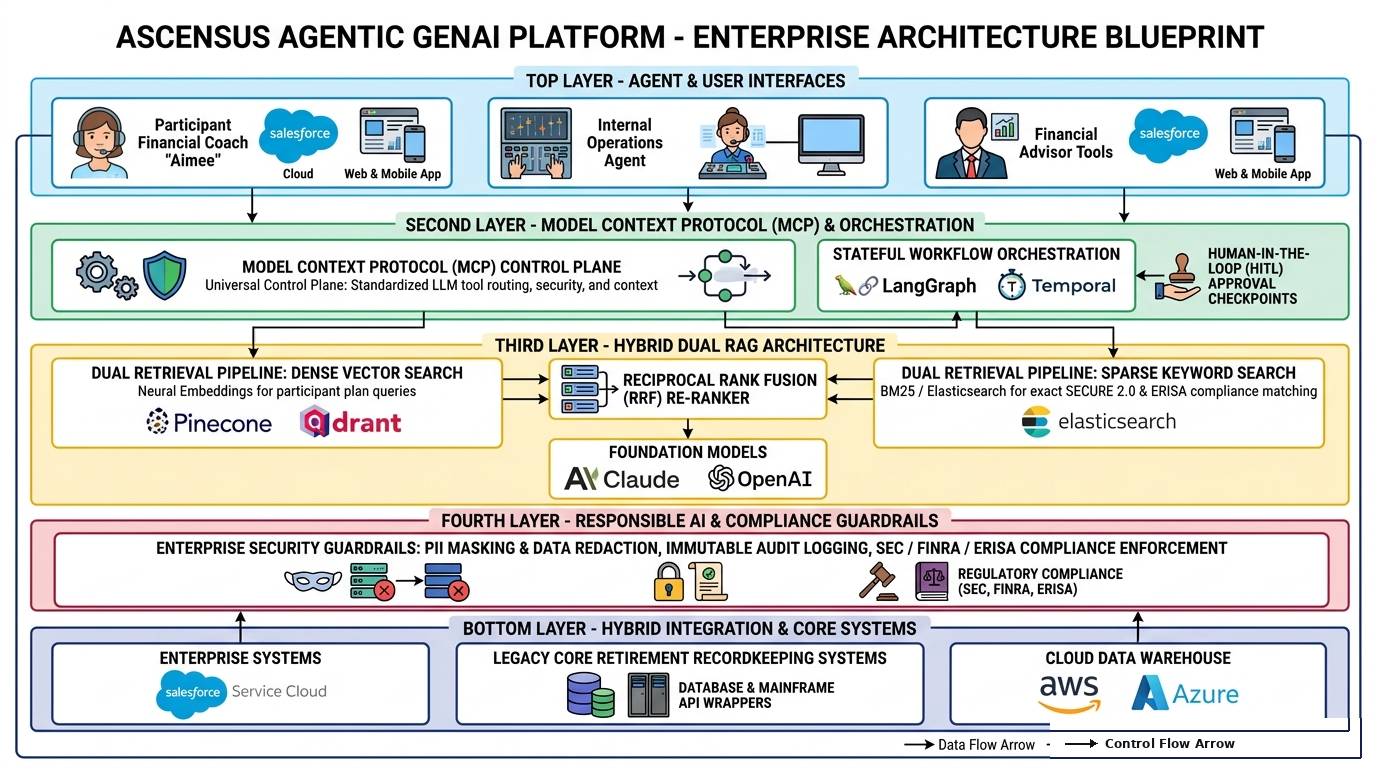
The 5-Layer Agentic AI Blueprint Breakdown
Layer 1: User & Agent Interface Layer
- Components: Participant Virtual Coach ("Aimee"), Advisor Central Portal, Internal Operations Workstations, and Salesforce Service Cloud integrations.
- Function: Front-end UIs capture participant intent (e.g., "How much can I withdraw for a hardship distribution under SECURE 2.0?"). Rather than calling backend tools directly, Layer 1 routes requests via standard REST/WebSocket APIs into the Layer 2 Agent Middleware Tier.
Layer 2: Durable Runtime & MCP Control Plane
- Components: LangGraph / Temporal Stateful Orchestration Engine, Model Context Protocol (MCP) Client/Server Control Plane, and Human-in-the-Loop (HITL) Checkpoint Registry.
- The SolutionJet Difference (Replacing Custom Wrappers with MCP):
- The Problem: Traditional custom tool wrappers require developers to manually hardcode schemas, authentication, and context passing for every single endpoint. When legacy recordkeeping APIs change, agents break unpredictably.
- The MCP Standard: MCP acts as the universal control plane. The LLM Harness acts as an MCP Client, while legacy databases, Salesforce CRM, and RAG indexes expose standardized MCP Servers. Tools are dynamically discovered, authenticated, and rate-limited under a unified security protocol.
- Durable Execution: Long-running financial workflows (e.g., 401(k) rollover verification) are managed by LangGraph/Temporal with state persistence. High-risk transactions trigger Human-in-the-Loop (HITL) gates before executing money movement.
Layer 3: Dual RAG & Hybrid Knowledge Layer
- Components: Dense Vector Search (Pinecone/Qdrant), Sparse Keyword Search (Elasticsearch/BM25), and Reciprocal Rank Fusion (RRF) Re-Ranker.
- Function: Financial compliance requires zero-hallucination accuracy over legal plan documents and evolving federal regulations.
- Dense Retrieval: Neural vector search retrieves conceptual financial guidance and participant coaching context.
- Sparse Retrieval: BM25 keyword matching pinpoint-retrieves exact regulatory clauses (e.g., SECURE 2.0 provisions, ERISA rules, SEC/FINRA statutory limits).
- RRF Fusion: Merges dense semantic intent with exact keyword precision, delivering bulletproof context into foundation models (Anthropic Claude / OpenAI).
Layer 4: Responsible AI & Regulatory Governance
- Components: Automated PII Masking & Redaction Engine, Role-Based Access Control (RBAC) Guardrails, and Immutable Compliance Audit Logs.
- Function: Operating under SEC, FINRA, and ERISA regulatory oversight demands strict data isolation. Layer 4 sanitizes participant social security numbers and account IDs before prompts hit foundation models, while logging every LLM reasoning step and tool call for regulatory auditability.
Layer 5: Enterprise Integration & Core Data Layer
- Components: Salesforce Service Cloud, Cloud Data Lakes (AWS/Azure), and Core Retirement Recordkeeping Mainframes/Proprietary Engines.
- Function: Bi-directional integration bridges legacy backends to modern cloud infrastructure without touching core transaction logic.
Enterprise & Business Value
Deploying this target architecture unlocks massive operational and strategic advantages:
| Modernization Vector | Legacy Custom Wrapper Approach | SolutionJet MCP Target Architecture |
|---|---|---|
| Tool Integration | Fragile, custom-coded REST/gRPC wrappers | Standardized, plug-and-play MCP Servers |
| Modernization Risk | Requires high-cost, risky mainframe rewrites | Decoupled abstraction; backends stay intact |
| Regulatory Compliance | Ad-hoc prompt filtering across endpoints | Centralized Layer 4 PII redaction & SEC/FINRA logs |
| Time to Market | 6–12 months per agent capability | Accelerated deployment via AI-assisted engineering |
| Workflow Safety | Stateless script executions | Durable state machines with Human-in-the-Loop gates |
Key ROI Impact for Ascensus:
- Accelerated Processing Timelines: Reduces participant distribution and loan processing turnaround times from days to seconds.
- Reduced Engineering Overhead: Standardizing on MCP eliminates thousands of hours spent writing and maintaining brittle API glue code.
- Enhanced Saver Outcomes: Equips tools like Aimee with real-time, zero-hallucination account context to boost retirement readiness for 16M+ users.
Why SolutionJet? Elite Technical Muscle for AI Transformation
At SolutionJet, we don't just build wrappers; we design modern, cloud-native AI architectures for complex financial service environments. With deep domain experience across 401(k), IRA, 529, and ABLE plan administration, combined with cutting-edge AI engineering practices (utilizing tools like Cursor and Claude Code), we bridge legacy infrastructure to modern AI capabilities efficiently.
Is your engineering team struggling with wrapper sprawl or complex legacy integrations?
SolutionJet conducts comprehensive AI Architecture Audits and delivers end-to-end MCP control plane implementations tailored to your enterprise stack.
👉 Contact SolutionJet today to schedule an architectural deep-dive with our lead systems team.